
Editor’s Note: This post has been updated for formatting and clarity. Some reflective comments were added in 2025.
It’s been fun going through the nice and nonsensical comments my peers have left on my short stories over the years. Some are helpful, some are supportive, some are mean and some are just plain funny. They’re a great way to remind my fellow writers—particularly those new to having their work critiqued—that everyone’s got an opinion.
Sometimes those opinions can hurt your feelings, but it’s important to look past that for any valuable input you can use. Just like when you read customer reviews, you tend to ignore the ones that just say “Awful product. Never buying from this company again” because there’s nothing there to advise you on why you shouldn’t buy the product. For all you know, that guy didn’t even read the product description before he bought the thing.
For this bonus episode, we’re actually going to take a look at some more comments left on the last three short stories I wrote. What makes these comments so special? Well, they come from my professor. I’ll go ahead and give him the benefit of the doubt—it’s the end of the year, the loud class next door has been bugging him all quarter, and there could be something in his personal life really stressing him out. This is the first time his comments have proved less useful and—as in the first picture below—a little hurtful.
Instead of launching into a defensive tirade, I want to use these comments to show you all that even professors, who we sometimes put on a pedestal for all their wisdom and experience, can offer less than helpful feedback.

This wasn’t the first fantasy story I’ve passed off as historical fiction for this professor, but it’s the first time he’s responded in this way. (If you want to see what my classmates said, you can read Best and Worst of Critique Comments #3.) This story earned an A, so I’m at least doing something right. But that just makes the threat of a lower grade bizarre. (To clarify, when he said “you’ll start with a C,” he meant that a C is the highest grade I could get if I did everything else perfectly.)
This professor also doesn’t like genre fiction—he prefers contemporary realistic fiction—so I’m taking this particular comment as an opinion of taste rather than objective assessment of quality. Taste should have no bearing on a grade.
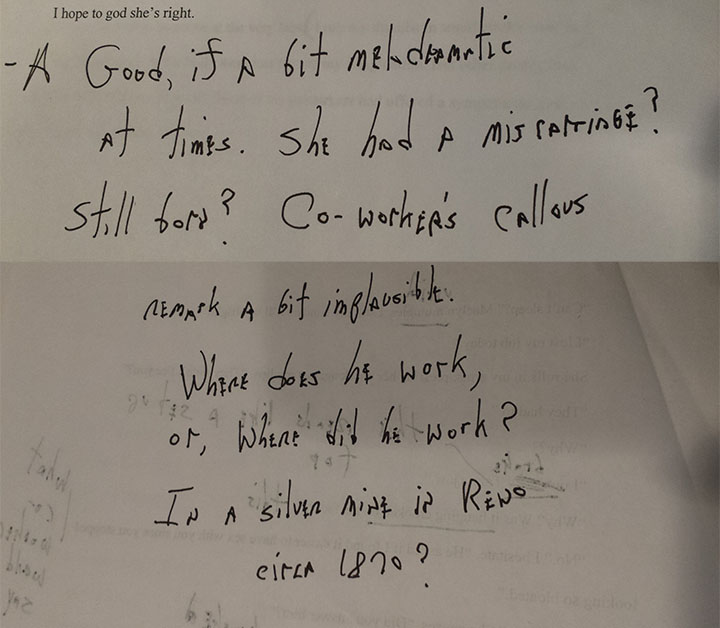
For my contemporary story about the married couple that had a miscarriage, my professor generally felt it was melodramatic. (For my classmates’ feedback, read Best and Worst of Critique Comments #4.) During verbal critique, he offered some rather morbid suggestions on how to adjust the situation to be “more dramatic,” such as turning the accidental miscarriage into an abortion forced by the husband. This question about where the husband works that a coworker would make such a callous comment about the wife seems odd, especially given its phrasing.
Sure, I have years of anecdotal proof that people, myself included, can make tactless remarks without thinking. I think we’ve all said things and realized a few seconds later that, gee, I really shouldn’t have said that. But it’s hard to tell if what I wrote sounds more like intentional insensitivity when my only feedback is a quip. It’s important to explain why something doesn’t work when critiquing.

Perhaps the least helpful feedback (as far as clarity on what changes are needed to improve the story) comes on the last story I submitted. Only the professor read it, so I can’t use my classmates’ comments to help decipher what’s “wrong” here. I guess any mentions of giant machines during an alien invasion will bring to mind War of the Worlds, but I’ve never seen any Robo Cop. Regardless, most writing is derivative of something these days.
What’s not working with this feedback is, again, that I’m not being told what isn’t working. Is it the “romantic voice” people have said I write in? Is the presence of a female character—who spends the whole story freaking out and trying not to bleed out from a gunshot wound—to blame for the “woman warrior” feel? What exactly am I supposed to change for the revised version?
As you can see, my friends, comments you don’t know how to respond to can come from anyone. They could even come from you. If you get responses like this, ignore what won’t help you. And if you’re critiquing someone else’s work, remember to explain why you think a change is needed.
Update: A Few Things I’d Add Today
When I originally wrote this post, I was torn between feeling like I had a good reason to be angry with my professor and like my anger had to be a sign of my immaturity as both a person and a writer. So I tried to let his comments speak for themselves.
My first thought when looking back on this: I got far more out of my classmates’ critique comments than my professor’s. I think, at the time, I did have a sense that the stories I wrote to be read to my classmates were a better litmus test for my writing style, characters, and the kinds of things I wanted to write about in novels, while the stories that only the professor read were more about trying to stay on his good side and get a good grade.
It’s hard not to wonder if he had some personal issue with me, or with my writing. A friend who took these classes with me said he was like this with everyone and his written comments always came off feeling like he was personally offended by something in the story.
I wish I could find the file for the third story mentioned here so I could remember it better. I wonder if it was something I wrote to revisit the novel I first drafted in high school. It’s the only work I can remember that mentions giant robots, and it was the story I thought would end up being my debut novel. However, I don’t remember writing anything romantic after he called the 500-word short story “melodramatic.”
I’m glad my past self made such an effort to focus on differentiating between valuable feedback and placing value on feedback because of who is giving it. I know I felt very hurt at the time. Now, I know to be careful about choosing critique partners or groups. It’s important to find the people who will give worthwhile feedback.


 The AJSWITZY Project