
Editor’s Note: I’ve noticed this post getting traffic due to controversy surrounding Emergenetics. Just to clarify, I’m not affiliated with the company and I’m not advocating for or against their personality assessment. I’ve updated some sections for formatting and clarity (2025). Carry on.
Whether it’s just to find out what kind of bread I am or actually understand more about how my mind works, I enjoy taking personality tests. It’s fun and fascinating. As an added bonus, it inspires me to add deeper layers to the characters I write, making them more complex and enjoyable to read. If that sparks your curiosity, check out my posts on character development.
For this post, I thought it would be fun to share my Emergenetics Profile, which defines preferences through behavioral and thinking attributes. I took the assessment in 2019 as part of a team-building exercise arranged by my employer, but I occasionally like to reread my results and see if it triggers any new introspection. Especially knowing sourdough is the bread of my soul.
A Little Bit About Emergenetics
Drs. Geil Browning and Wendell Williams of Emergenetics International created a personality assessment to help people understand how they approach work and life. It combines the genetics with which we’re born and the characteristics that come from life experiences to determine an individual’s temperament. The results are along a spectrum of three Behavioral Attributes and four Thinking Attributes.
A note within the assessment results points out everyone is able to use all the Behavioral and Thinking Attributes. But everyone has a natural comfort level with each attribute. “It is possible to ‘stretch’ attributes like a rubber band when necessary, but operating outside your comfort level takes more energy and will tire you out more quickly.”
3 Behavioral Attributes: The Way You Act (What People See First)
- Expressiveness – your level of sharing what you are experiencing on the inside with the outside world
- Assertiveness – the amount of energy you invest in expressing your thoughts, feelings, and beliefs
- Flexibility – how much you are willing to accommodate the thoughts, actions, and interpersonal needs of others
4 Thinking Attributes: The Way You Think (What People Can’t See)
- Analytical thinking is rational, inquiring, and clear. The Analytical part of the brain wants to see data and research.
- Structural thinking is detailed, practical, and methodical. The Structural part of the brain follows rules and is cautious of new ideas.
- Social thinking is relational, collaborative, empathic, and supportive. The Social part of the brain is team-oriented and socially aware.
- Conceptual thinking is imaginative, unconventional, and visionary. The Conceptual part of the brain likes change and is easily bored.
Overview of My Emergenetics Profile
Since originally taking the assessment in 2019, there have been a few significant events that might affect my results if I took it again. A worldwide pandemic, for one. Marriage and a baby, too. That said, I don’t disagree with what this report says about me.
Preferred Thinking Attributes
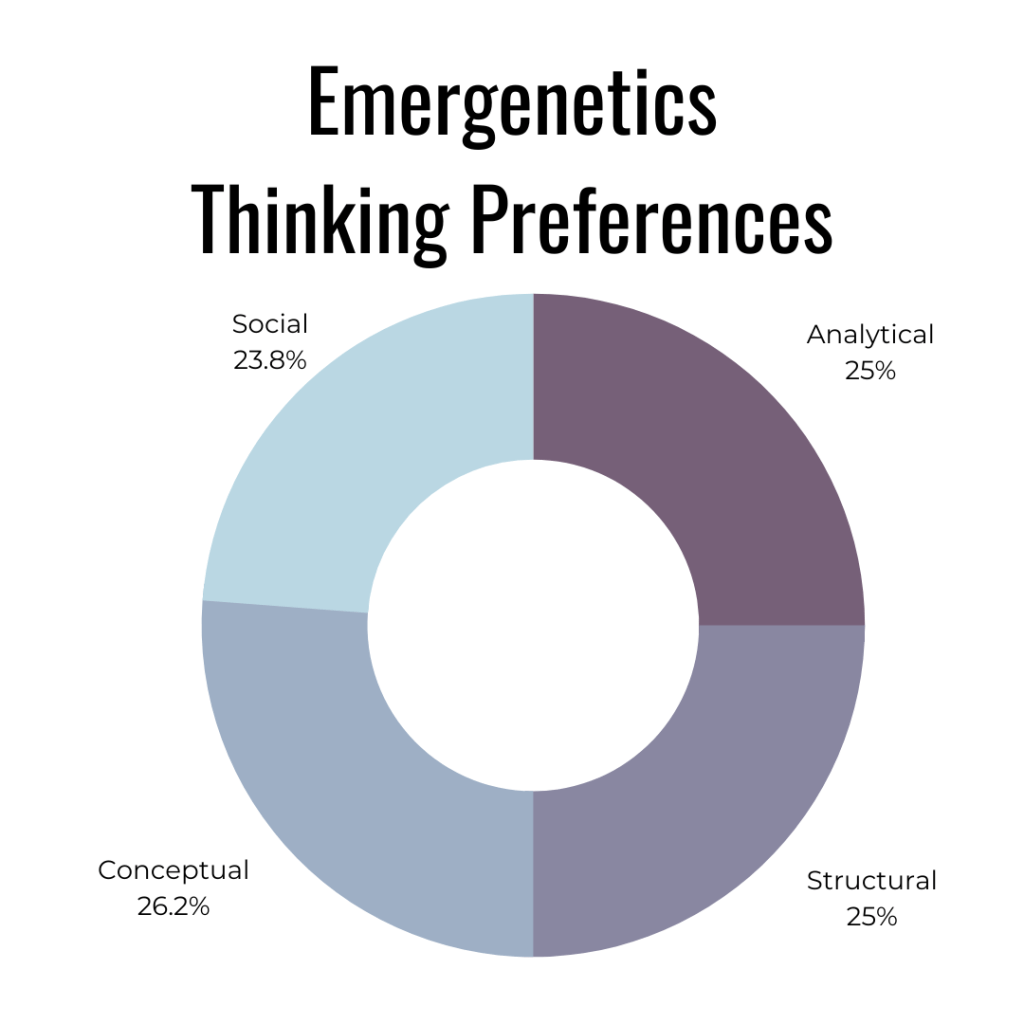
- Analytical (25%) brain is capable of theoretical thinking but is not fanciful, and bases decisions on facts and data.
- Structural (25%) brain is task-oriented, dependable, and efficient, basing decisions on sequential reasoning.
- Social (23%) brain feels connected to emotions and others. It bases its decisions on intuition and the expertise of others.
- Conceptual (26%) brain is theoretical, not concrete. It tends to ask, “What’s the concept here, and where can I go with it?” It bases decisions on intuition and inspiration.
This part of the report kind of made me feel like a unicorn because Emergenetics claims a true multi-modal Profile—where all the thinking preferences are nearly even—is only seen in 1% of the general population. That’s kind of awesome and makes me feel like I have a superpower!
But the detailed description of what that really means paints a pretty stark either/or situation for me:
The Multi-Modal Emergenetics Profile
“You are capable of using both rational and intuitive thinking, as well as both concrete and abstract thought processes. You have the capacity to relate to anyone and to do any type of work.
People with this Profile tend to be either very successful or very bland. When people with this Profile master it, they learn to relate to all kinds of minds while still being able to make firm decisions. Those who have not yet mastered this Profile may second-guess their decisions, and the end results may be nondescript.
You may be able to communicate very well with others since you can relate to how others think. Your challenge is that you do not stand out from the crowd. You will probably rise in your organization quickly because you have been able to take on many different kinds of jobs. However, after this, your career may stagnate if you have not become an expert in any one area.
Here’s a thought. If you are not compelled to pursue any particular talent, field of study, or area of expertise, just pick a career and learn how to do it exceptionally well. Do not wait for a sign that a particular job is the ‘right’ one, as in the meantime everyone will be passing you by.”
Behavioral Attributes
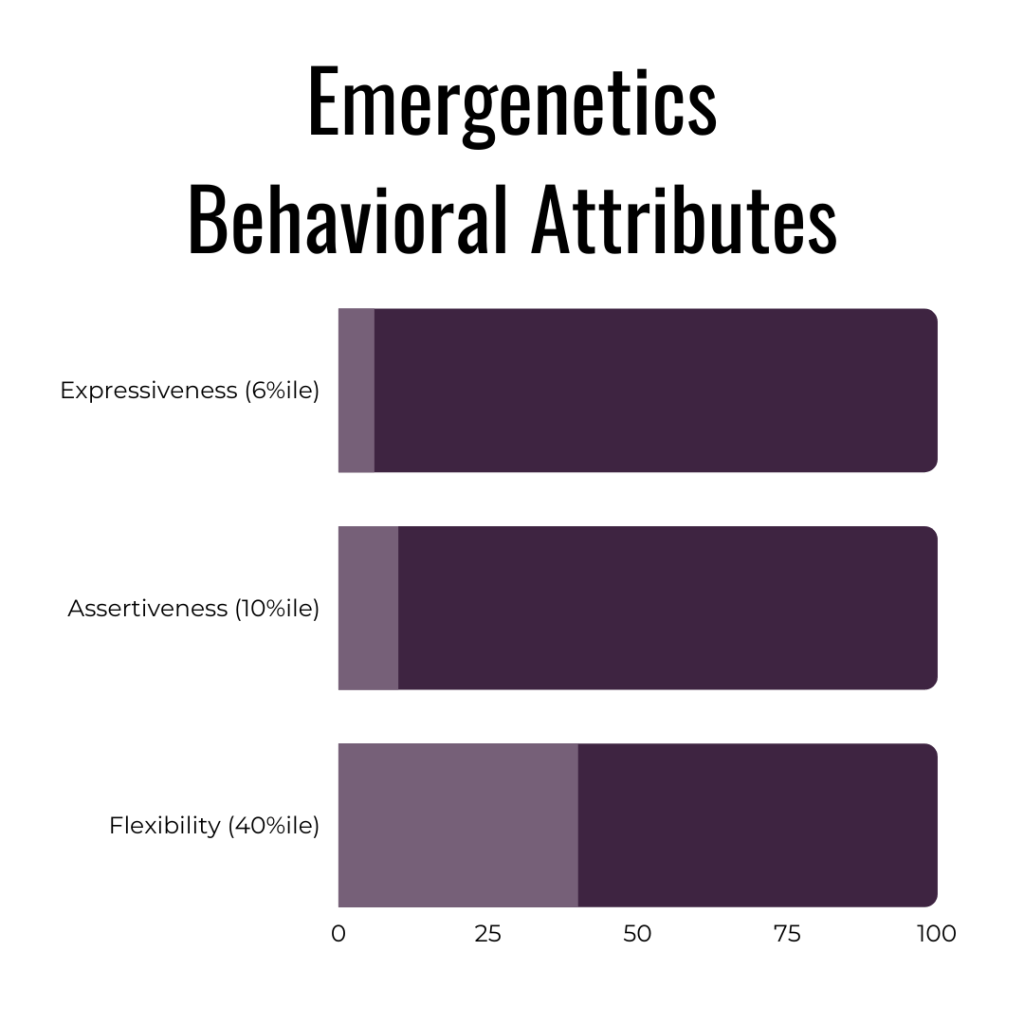
- Expressiveness (6%) is in the first third, meaning I’m usually calm, thoughtful, and quiet.
- Assertiveness (10%) is in the first third, meaning I’m usually amiable, easygoing, and supportive.
- Flexibility (40%) is in the second third, meaning I may be more easygoing or firm depending on the situation.
For this part of the report, I’m not totally sure how accurate it still is. I’d say my Flexibility is probably in the same range because I do still wait to understand a situation before deciding if I want to be more accommodating and easygoing, or more focused and determined with a solid idea or goal in mind.
However, given the amount of work I’ve put into intentionally changing my mindset over the last few years, I wonder if my Expressiveness and Assertiveness levels might look different now. But this is what the report says my Behavioral Attributes say my behavior is typically like:
Expressiveness
“You are probably calm, thoughtful, and quiet. In general, you probably keep your thoughts to yourself, your facial expressions may be stoic, and you maintain confidential information easily. You may learn by listening and reflecting. You don’t waste words, and you tend to think before you speak. You generally prefer one-on-one conversations or small gatherings over participating in large groups. If you must spend prolonged periods of time with people, you may eventually need to retreat to privacy, which you find energizing. Because you are generally reserved, you may be perceived as less emotional (which may or may not be the case). When you are working in a team, you are often the calming influence on those around you.”
Assertiveness
“You are probably amiable, easygoing, and supportive. You generally choose to go along with most decisions and tend to keep your opinions to yourself on most things. You probably steer away from confrontations and most likely are viewed as a peacekeeper. You tend to be deliberate and may complete tasks at your own pace. Because you are genial and your voice is generally even-toned, you may risk being overlooked.”
Flexibility
“You are in the “It Depends” group. You may behave in a more easygoing manner, or you may take a firm position. Depending on the situation and your companions, you decide how much energy you want to put into being affable and easygoing, or determined and uncompromising.”
Final Thoughts (Reflections from 2025)
For the Professional Team
I’ve seen the criticisms of personality assessments like this one that say the methodology is based in pseudoscience on par with astrology. Whether or not that’s true, I don’t think that negates its usefulness in the right context.
As a team-building experience in the workplace, I saw immediate value in participating. Employees across different departments who often had to collaborate yet only knew each other over email finally got to meet in person. Once we all had our results, it helped start some important conversations about communication.
I remember one colleague showed off their higher scores of structural and analytical thinking, then said, “Yeah, facts and data are important to me. If you want to come to me with a new idea, give me that stuff first. Then I’ll be happy to listen to the rest.”
Another colleague scored highest in conceptual. They said, “I need to understand the full picture of what you want to accomplish in order for me to do my part the best I can. I’ll still deliver something if you only give me the bare minimum of what you think you need, but it’s not going to be the best I can do or what’s best for your project.”
P.S. If you made it this far, you might like what else I make.
I write stories and reflections on the creative life—sometimes messy, often weird, always honest. If you’re curious:
- Peek into my creative process with Don’t Let the Void Destroy Success and Other Good Feels
- Try a new ritual with How to Create a Reward System to Stay Productive
Wander where you will.


 The AJSWITZY Project