
Legacy Collection: Free Short Stories From my Student Years
This collection features pieces I wrote during my college years for writing assignments. A few of these stories are ones I’m genuinely proud of: built around ideas I loved and written with everything I had. Others? Well… they were turned in because deadlines exist and grades were on the line. Either way, they each mark a step in my growth as a writer. I’m sharing them here as a way to honor where it all started.
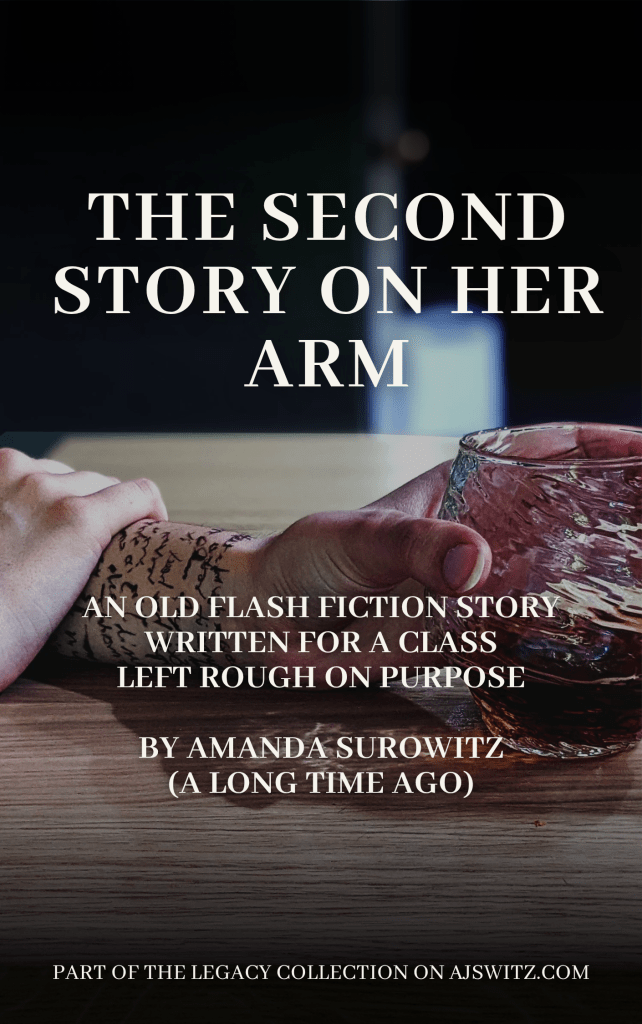
Caisri bent over his artwork, wiping drops of blood from his apprentice’s arm. He promised her they would take a break once he finished another three inches of her tattoo, but she didn’t seem impatient. With her unfocused gaze looking past the clouds outside, her body settled into the chair like a fine coat of dust.
“Have you thought of the next story you want on your arm?” Caisri asked. He pricked her arm again and again with a sharp bone coated with ink. Blood beaded on her skin.
“I’m putting them all on my arms,” Justine said. “That’s why I asked you to make the letters small.”
“I think you mean you demanded I keep them small.” He set his bone aside and got up to stretch. He crossed the length of the small cabin and opened the door, leaning against the frame to bask in the dry afternoon breeze.
Nothing caught his eye, but that was the point. His people learned to survive in the desert without anything but the earth to help them. Caisri may have strayed from his tribe more than a decade ago, but he still passed on their teachings. He may not have the most honorable students—mostly thieves, guns for hire, and the insecure sought him out—but they certainly dedicated themselves to learning a noble practice.
He closed the door and returned to the table, ready to continue working.
Justine stared at the black markings circling her wrist. Caisri admired the design. It was a swirling array of black lines and knots embellished with tiny letters describing her past. He did this for every apprentice he took on, but none of their tattoos stirred the same pride in him.
“It’s archaic.”
Caisri laughed. “You wanted to learn the traditional practices of an ancient culture. Get used to archaic.” Justine conceded with a nod, and Caisri sobered. “You’ll need to tell me the next event to write.”
The reminder of why an initiate wanted to learn would help focus them in the brutal year they spent learning to live and fight like Caisri’s ancestors. Most of his pupils couldn’t read, so their tattoos were a collection of images detailing the moment they decided to seek him out. Justine could read, and the amount of text she wanted on her arms was only the first thing to set her apart from any student Caisri had ever taught.
Justine laid her arm on the table and turned to stare out the window again. Caisri leaned back in his chair, already picturing the next design to etch onto her skin.
“The fever took your eldest brother when you were twelve,” he offered when her silence stretched on. “What happened after that?”
“I was the eldest of seven then. A whole army of younger siblings depended on me. The drought went on that year, devastating our family’s farm. We barely grew enough to sell at the market in Asica, let alone feed ourselves. A lot of the farms in the area suffered, too, but families that could afford a better irrigation system were better off. There was one about half a mile from us.
“I’d sneak over in the middle of the night, keeping low in the field until I had to climb over the stone wall that guarded their cellar. It wasn’t attached to the main house. An old man kept watch in front of it, but I always came over in the back. They had a lock on the cellar door, too. I had to go back four or five times before I finally figured out how to open it.”
“Did everyone keep their cellars so heavily guarded?”
“If they had a lot to protect, sure. I wasn’t the only one in the area stealing. There were criminals on the run, other hungry families… Thieves weren’t uncommon. I never took a lot. At the end of every week, I only took enough to make up for what we ate. Since we ate sparingly, I didn’t have to take much. They eventually noticed their stores depleting and got some dogs. After one of them nearly took my hand off, I never went back.”
Caisri nodded absently; he’d noticed some scars that fit her story. Perhaps he could incorporate them into the tattoo rather than obscure them. Knowing how close she was to her family, a thought struck him. “Did your family know what you were doing?”
Justine shrugged as if it didn’t matter whether they knew or not, but the crease that formed between her eyebrows said otherwise. “Not at first. My father was pissed when he realized why we never ran out of anything. He said he didn’t raise thieves and I could sleep on the roof until I remembered how a daughter should act. I told him I’d be spending a lot of nights up there because I wasn’t about to let my brothers and sisters starve.
“He only made me sleep up there for one night, but he stopped speaking to me after that. He began every meal by telling us that doing dishonest things like lying and stealing would make our teeth fall out. He accepted whatever I brought home—whether it was money or food—but he never said anything. He still let me go with him to Asica, even though he knew I stole from nearly everyone I bumped into.
“I stole from merchant stalls at first, then started cutting purses and picking pockets. I never did it around my father. He went off to sell whatever we could afford to lose and I would go on my way and get to work. I wasn’t picky about my marks, but I tried not to steal from the same person twice.
“We lived like that until spring came. My mother finally got my father to speak to me again, and he told me he didn’t want me stealing anymore. He said it was likely we would get plenty of rain that year.”
Caisri waited patiently. His students always reached a point where they found discussing their past difficult. Instead of pressing the matter, he stood and crossed the room to a cabinet. He took a bottle of whiskey and two glasses out and brought them back to the table.
Justine took the drink he poured her. He ignored his own glass. When he first told her to tell the story of why she came to him, he hadn’t taken her answer seriously. Everything that’s ever happened to me has led me here, she said. There had to be four more years of her personal history at least.
He imagined the black lines and slim letters he would draw. They would probably reach all the way up to her shoulder. But based on what he knew of her, Justine probably had enough reasons to be here to cover both her arms with script. He could picture it—it would look similar to his own tattoos. The plain lettering covered his left arm between his wrist and elbow. Hers would be more artistic with all the interlaced knot-work he planned to incorporate, but it would be the most traditional tattoo he ever gave to a foreigner.
Justine downed another glass of whiskey before she resumed her story.
“My father said we’d have plenty of rain that year, and he was right. Our crops grew and we were back on our feet. I didn’t have to steal anymore.” She smiled wistfully and twirled the empty glass in her hand. “But I did anyway. I’d gotten good at taking things unnoticed and I didn’t want to stop. I’d go to Asica with my father and I’d bring home trinkets—trophies, if you will. I put more thought into choosing a mark.
“One day, I saw a family at the market. There were dressed nicely—not the richest folk, but richer than my family. I think it might have been their son’s birthday. I watched them for a while, making sure they didn’t see me. They bought many nice things for the son, and he was grateful for all of it.
“Something about seeing all their wealth and knowing my parents couldn’t give so many gifts to my brothers or sisters on their birthdays annoyed me. As I continued to follow them, my irritation grew. I had to do something to put them on my level.
“I had just started to work out a plan when a nearby street performer caught their attention. The opportunity looked too good to miss. While they delighted in watching the woman dance, I stayed underfoot and took the father’s purse. That should’ve satisfied me, but it was light from all his spending. Jealousy clouded my judgment; if I’d been thinking rationally, I would’ve gone the moment I had his money. But I wanted them to feel their loss.
“I took several of the son’s new trinkets from his pockets, forgetting to take their weight into consideration.” She shook her head at the simple mistake. “He realized what I was doing and caught me by the arm. I was so surprised, I overreacted and punched him in the face. He let me go and I ran to the other side of Asica, thinking I’d gotten away. I started to look for my father when the man I stole from found me.
“He was furious not only because I’d stolen from him, but because I broke his son’s nose. He lectured me about causing his family misery on his son’s birthday, told me my teeth would fall out if I didn’t live honestly, and made such a fuss that one of the Asica guards came over to see what he was shouting about.
“The rich man told the guard what I’d done, but insisted he had it under control. When the guard saw how much I returned to the man, he claimed my criminal impulses were no more reversible than a plague. He arrested me on the spot and marched me through the street as an example.
“My father decided to appear then. He told the guard I was his daughter and that he would cure me of my evil ways. He begged the man not to throw me in jail or make a public display out of me. The guard refused, saying thieves didn’t last more than a few days in Asica. I decided it wasn’t it my best interest to point out I’d been stealing in the market for nearly a year before he caught me.
“He put me in a cell with other pickpockets—most of them children near my age or younger. They were filthy, and the way they stared at me… They didn’t know if I was a threat or their next meal.”
Caisri frowned. He was skeptical of cannibalism among children in jail—even if they were hungry enough to resort to such a practice, he couldn’t imagine the jailor would allow it. But the ghost of memories in Justine’s eyes made him wonder.
“Did they decide which one you were?” he asked. Justine shrugged.
“I didn’t give them an opportunity to. It took more finesse than most thirteen year-olds can manage, but I slipped through the bars. I suspect the others figured it out after I left. The sun had already gone down by the time I was out, so I figured my father was already home. I ran as fast as I could, ready to apologize and promise never to steal again.
“When I got there, neither my mother nor father was there. A neighbor and old friend of our family was instead. He said my parents went back to Asica to demand my release—or pay for it, if they had to. They asked him to stay and watch over my siblings while they were gone. I didn’t know how to write then, so I asked our neighbor to give my parents a message when they came back.
“Everyone would probably figure out I went home after escaping jail, and they’d lock me up tighter the second time. Even if they didn’t arrest me again, I didn’t know what my father would do. So I told our neighbor to tell them I left—that the guard was right and I could no sooner end a plague than stop stealing from everyone in sight. If I did manage to change, however, I promised I’d return.”
“Did you ever try going back?” Caisri asked. Justine laughed.
“About a month later. I moved a few towns over and kept up my thievery. I took what I needed to live, then dropped off the rest on my family’s doorstep. I kept that up for a while until I became one of the most wanted criminals in the area. It’s funny how fast that can happen.”
He knew exactly how fast it happened; his tribe exiled him after doing the exact same thing. Despite not encountering his people since he built his cabin, Caisri was still notorious among their various tribes.
He finally drank his whiskey, again staring at her arms. He almost finished the tattoo design in his mind, but he needed one more piece of information from her before he could begin.
“How was this a step in my direction?”
“Because all my crimes are done in the name of my family. I don’t give a damn if you or anyone else thinks that doesn’t justify my actions,” she added. “Petty thievery wasn’t enough to make up for taking another child from my parents. I may head to the coast and resort to piracy. But I need to have something better to offer than what I already am.”
Caisri took the whiskey and glasses away, returning to the table with another bottle of ink. He wiped the sharp bone needle clean and inspected the tip carefully. “Have you considered the thieving crews in the cities? Previous students have told me they’re quite successful.”
The corner of her mouth quirked. “Where do you think I learned to read and write? Or where I first heard of you?”
Caisri smiled, dipping the needle into his ink. Justine stretched her arm before him and relaxed in her chair, once again turning to stare out the window. She twitched the first time the bone pierced her skin, but remained still after that. He only spoke again when he needed a reminder of some details in the story.

For more about this short story, modern-day reflections on craft and the process behind writing this piece are in Reflections on Writing “The Second Story on Her Arm.”


 The AJSWITZY Project
Don’t just lurk, say something! The comment section is open for your mildly unhinged opinions.