During my days as a public relations and marketing writer, I had the privilege of covering Carrie Mae Weems’s keynote lecture as the honoree of SCAD deFINE ART 2016 conference for the university blog. I remember sitting in the darkened audience, taking notes without taking my eyes off the stage, waiting to feel the resonance of the best quotes. She didn’t make it easy. Her whole speech was a beautiful, emotional journey I wished I could take with me. But I could only take pieces. And I felt the weight of the strongest one the moment she said it:
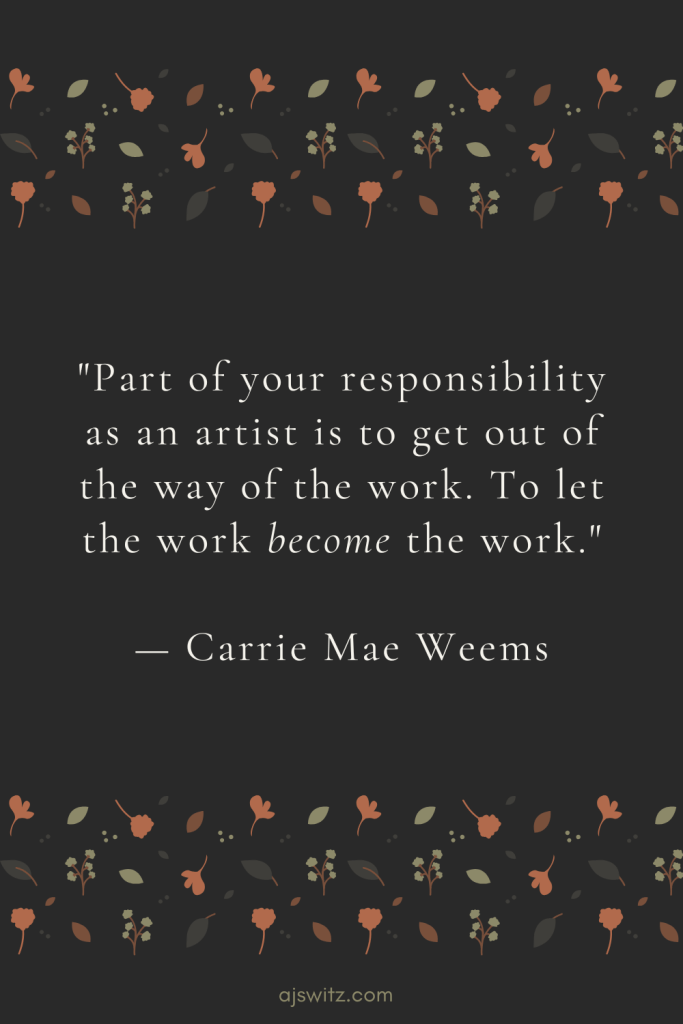
“Part of your responsibility as an artist is to get out of the way of the work. To let the work become the work.”
Carrie Mae Weems
In the years since, as I’ve pursued my own creative path and met countless other creatives navigating doubt, ego, and process, this advice has taken on new meaning for me.
What Does “Let the Work Become the Work” Mean?
At the time, I thought I understood what Weems meant. I took her words as permission to ignore advice I didn’t like. To not do the work I didn’t want to do to turn my manuscript draft into a published novel.
I wanted it to be easy. Write the story. Revise a few times. Meet my dream agent at a conference. One more light edit with a publisher. Then hand things off to a competent, supportive team and move on to the next book.
How annoying is it that it’s not that simple at all?
Instead of questioning that assumption, I told myself “letting the work become the work” meant staying focused on story and craft. Let others worry about structure, positioning, and audience. I believed my job ended where the art began.
It’s painfully obvious now that I missed the point.
Creative work starts as something private. We know our ideas by feeling rather than sight. Bringing them into the world requires a certain arrogance. We must believe no one else can make this thing as it wants to be made the way we can.
That arrogance is necessary. It’s what gets the work started.
But it’s also what tempts us to ignore the things that help the work survive outside our own inner world.
Research, comparisons, critique, revision, restructuring—these can feel like threats rather than tools. We worry that too much outside influence will dilute the work. Or worse, turn it into something driven by the market instead of meaning.
What arrogance fails to see is that these steps aren’t about replacing your vision. They’re about translating it—and yes, turning it into something you can be paid for.
If your creative work is only for you, there’s no need to get out of its way. But if you want it to reach others, it can’t stay entirely inside you.
At some point, you have to step aside, listen, and let the work meet the world.
What Does it Mean Now?
In 2026, “getting out of the way of the work” is harder, not easier. We’re burnt out trying to keep up. The pressure to produce, be visible, and stay relevant is immense.
It’s no wonder so many turn to tools promising speed and ease. But it’s at the expense of the environment, consent, authorship, and the people whose work made those tools possible. But there’s no ignoring the troubling ways AI is used and the consequences of that use.
In creative industries, AI is used to remove people: from credit, from compensation, and from the creative process itself. Authors and artists don’t get to consent to having their work fed to training data. Creatives across disciplines have spoken out about the harm of unlicensed AI ingestion and the loss of control over how their work is used, as well as concerns for the future of art itself.
Designers and illustrators are bypassed due to the inconvenience of paying a human for their work. That work that is then handed to AI with a prompt to imitate it. This repeated experience raises urgent questions about authorship, originality, and theft—questions explored in depth in Original or Stolen? The Battle Between AI Image Generators and Visual Artists.
People who never sat with the difficulty of writing or the exhilaration of creative flow churn out book after book.
The market is flooded with slop. The noise we all try to rise above to be heard is louder. What’s taking up our space and attention is hollow, devoid of lived process and responsibility.
This is not the way to help the work become itself. It erases the creator. What’s left behind may look like a finished creative work, but it hasn’t been touched by life. No struggle, no revision, no care. And we can feel the absence.
Stepping aside doesn’t mean rushing to get it done by any means possible, or handing it off to someone else. It means staying in the work long enough for it to demand something of you and having the courage to give it your all.
How to Get Out of the Way of Your Work
It’s not about stepping back entirely or surrendering responsibility. This is about learning when to act and when to listen. It’s a practice of resisting the urge to rush. It’s a promise to hold yourself accountable to what you’re making and how you choose to bring it to life.
For me, that practice has taken shape through a few simple habits. None of these are shortcuts. All of them ask for patience, curiosity, and care.
- Start with curiosity, not control. Observe your creative work as it is and where it seems to want to go.
- Separate judgment from process. Let go of intrusive thoughts comparing where it is now to what you want it to be.
- Experiment freely. Draft, sketch, and revise without letting your creative ego decide too soon what’s “right.”
- Listen to feedback and to the work itself. Sometimes your subconscious leaves clues in your work that your intuition can follow to solutions.
- Give your work space. Walk away, sleep on it, revisit it after you’ve given your creative energy a chance to rest.
Creativity thrives in rhythms and cycles, not constant pressure to produce. The work will become the work when you let it show you what it wants to become.


 The AJSWITZY Project
Don’t just lurk, say something! The comment section is open for your mildly unhinged opinions.